


"You'll lose weight as long as you're in a calorie deficit"—This statement is only half true.
A calorie deficit makes you lose weight, but the source of your calories determines whether you lose fat or muscle, and how good your physique looks.
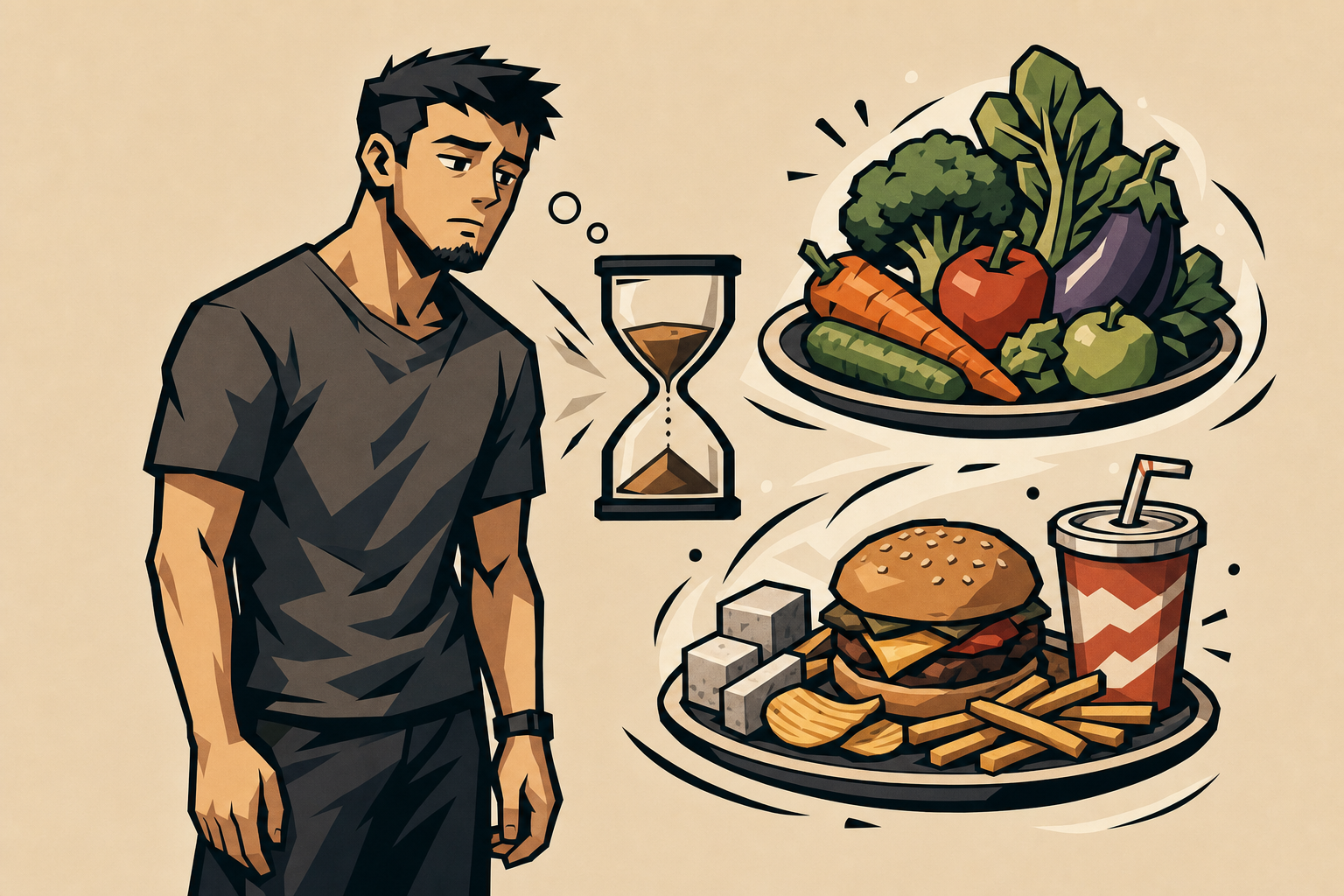
There's a saying in the fitness world: "A calorie is a calorie," meaning that as long as you create a calorie deficit, you'll lose weight no matter what you eat. Is this statement true?
Coach Kai's answer: Yes, but only half true.
From the perspective of the first law of thermodynamics (conservation of energy), as long as your calorie intake is less than your calorie expenditure, your weight will indeed decrease. In theory, even if you eat fried chicken, fries, and ice cream every day, as long as your total calories remain in a deficit, your weight will still decrease.
But the question is: Is your goal merely to "reduce your body weight number"? If what you want is a good physique, to preserve muscle, and maintain healthy bodily functions, then the source of your calories becomes extremely important. Just looking at the calorie number is far from enough.
Mr. A vs. Mr. B: Same Calorie Deficit, Drastically Different Physiques
With the same calorie deficit, individuals who consume enough protein retain more muscle and have a better physique, while those who eat junk food lose muscle.
Let's look at a specific case. Assume that both Mr. A and Mr. B's TDEE (Total Daily Energy Expenditure) is 2500 calories, and both aim for a 500-calorie deficit, consuming only 2000 calories per day. The difference lies in their diet:
- Mr. A: Eats whole foods such as chicken breast, brown rice, and broccoli daily, with sufficient protein and balanced macronutrients.
- Mr. B: Eats burgers, fries, and drinks soda daily, but strictly keeps his calorie intake under 2000 calories.
After a month, both individuals experienced a similar amount of weight loss—this confirms the decisive role of a calorie deficit in weight reduction.
The difference in physique is key
Because Mr. A consumed enough protein, he was able to retain or even slightly increase muscle mass, resulting in a more toned and defined physique.
Mr. B's diet was high in fat, high in sugar, and low in protein. A large proportion of the weight he lost was muscle. Although their body weights were similar in the end, Mr. B's physique was noticeably inferior.
Reason One: The Ratio of Macronutrients Determines the Direction of Body Composition
Protein protects muscle, carbs provide energy, and fats regulate hormones. The ratio of macronutrients directly determines the direction of body composition.
The food we eat, in addition to calories, also contains three major macronutrients: protein, carbohydrates, and fats. These three nutrients play completely different roles in the body.
Protein: The building block of muscle, the least compromising during fat loss
Protein is the primary building block of muscle. Whether your goal is to gain muscle or lose fat, consuming enough protein is crucial.
If protein intake is insufficient during fat loss, the body will break down not only fat but also muscle tissue, leading to a less sculpted appearance despite weight loss.
Coach Kai recommends a protein intake of 2 grams per kilogram of body weight. Consuming this amount is sufficient; there's no need to aim for 2.5 grams or 3 grams, as exceeding 2 grams won't lead to more muscle gain.
Carbohydrates: Fuel for training, not eating them doesn't mean you'll lose more weight
Carbohydrates are the body's main source of energy, providing the power needed for training, allowing you to complete higher-intensity workouts. Insufficient carbohydrate intake can significantly decrease training performance, indirectly affecting muscle gain.
Coach Kai explicitly states: Not eating carbs does not equate to fat loss. Many people find that reducing carbs seems effective, but the real reason is simply that their total calorie intake also decreases, not that carbs themselves have some magical effect.
It is recommended that carbohydrate intake be around 4 to 5 grams per kilogram of body weight, making up about 50% of total calories.
Fats: Raw material for hormones, completely cutting them out will lead to major problems
Fat is closely related to the body's hormone secretion. Adequate fat intake helps maintain a normal hormonal environment, which affects both muscle synthesis and overall health.
At the same time, fat is an essential medium for the absorption and transport of fat-soluble vitamins (A, D, E, K). Coach Kai suggests a fat intake of approximately 0.5 to 0.7 grams per kilogram of body weight, and it should never be completely eliminated.
Returning to the example of Mr. A and Mr. B: Mr. A, who ate whole foods, easily met his adequate protein and appropriate carbohydrate and fat intake; Mr. B, who ate junk food, typically consumed high-fat, high-sugar, and low-protein meals, leading to a severe imbalance in macronutrient ratios. Even with the same calorie intake, their body compositions developed in completely different ways.
Reason Two: Micronutrient Intake Determines "How Good You Look When You Lose Weight"
Whole foods are rich in micronutrients; long-term deficiency will make you feel sluggish, recover slowly, and look unhealthy and tired when you lose weight.
In addition to the three macronutrients, food also contains a large number of micronutrients, which are various vitamins and minerals. Although these micronutrients do not provide calories, they play countless important roles in the body, including maintaining immune function, assisting energy metabolism, and supporting nervous system function.
Micronutrients are usually found in whole foods like vegetables, fruits, and whole grains. Junk food and processed foods often contain only calories, with almost no micronutrients, which is why they are called "empty calories."
The long-term consequences of micronutrient deficiency are: feeling sluggish, easily becoming weak during training, slower recovery, and generally looking "unhealthy and lethargic despite losing weight." The weight on the scale might decrease, but overall health and vitality decline.
Reason Three: Satiety and the Thermic Effect of Food (TEF) Give Whole Foods an Edge in Calorie Management
Whole foods are high in fiber and provide strong satiety. Protein's thermic effect of food (TEF) reaches 30%, naturally helping you burn more calories.
Choosing whole foods also offers two often-overlooked advantages.
Satiety: Naturally reduces your calorie intake
Whole foods typically contain more dietary fiber, which provides greater satiety. For the same 2000 calories, you can eat a large plate of whole foods, but junk food might be gone in a few bites without leaving you feeling full at all.
Foods with high satiety naturally curb your impulse to "have a bubble tea" or "eat a piece of cake" in the afternoon. Choosing whole foods allows your body to receive complete food signals, which is a more natural and sustainable way to control overall calorie intake.
Thermic Effect of Food (TEF): Protein helps you burn a little more
The body itself expends energy when digesting food, a phenomenon called the Thermic Effect of Food (TEF). Among the three macronutrients, protein has the highest TEF, approximately 20% to 30%.
This means that for every 100 calories of protein you eat, your body needs to spend 20 to 30 calories to digest it. The thermic effect of carbohydrates is about 5% to 10%, and fat is the lowest, about 0% to 3%.
Returning to Mr. A's example: because he ate more protein, the actual calories his body absorbed would be slightly less than Mr. B's. Although the difference in a single instance is small, it adds up to a significant amount over the long term.
"Eating Clean" ≠ Strict Dieting: The 80/20 Rule for Long-Term Sustainability
Eat whole foods 80% of the time, and what you like 20% of the time. As long as the total intake is controlled, you won't gain weight, and your diet will be sustainable in the long run.
Having said this, some might start to worry: Does this mean I can only eat boiled meals and can never touch fried food?
Coach Kai recommends the 80/20 rule: 80% of the time, eat minimally processed, whole foods; for the remaining 20% of the time, you can eat some of the things you enjoy. As long as your total daily calorie and macronutrient intake are controlled, you generally won't gain weight.
Practical Example: Salty Crispy Chicken Can Also Be Incorporated Into Your Diet Plan
He even gave a very practical example: Suppose your daily calorie target is 2000 calories, and you eat very clean for breakfast and lunch—boiled eggs, sweet potatoes, blanched vegetables, boiled chicken breast.
By dinner, you still have an allowance of 30 grams of carbs, 30 grams of protein, and 20 grams of fat. You can absolutely use this allowance to order fried chicken cartilage and fried king oyster mushrooms from a crispy chicken stall. As long as the total intake is controlled, you won't gain weight.
Dietary sustainability is a concept that Coach Kai highly values. Forcing yourself to eat foods you dislike is the most difficult way to maintain a diet long-term.
Conclusion: Calorie Deficit Helps You Lose Weight, Calorie Source Determines How Well You Lose It
Total calorie deficit makes you lose weight; the quality of macronutrients and whole foods determines how well you lose weight and how healthy you are.
Summarizing Coach Kai's core stance:
- Total calorie control is the fundamental determinant of weight gain or loss; this major principle cannot be ignored.
- The source of calories determines whether you lose fat or muscle, and dictates the quality of your physique and your health status.
- The three macronutrients are indispensable: protein builds muscle, carbs provide training energy, and fats regulate hormones.
- Micronutrients, though not providing calories, are crucial for maintaining normal bodily functions and making you "look good" when you lose weight.
- The advantages of whole foods are: balanced macronutrients, rich in micronutrients, high satiety, and a high thermic effect of food, which helps you naturally control calorie intake.
- Occasionally eating junk food is fine, as long as it's kept within 10% to 20% of your total calorie intake, and adequate protein intake for the day is ensured.
"A calorie is a calorie"—yes, but only if your goal is simply to reduce your body weight number. If your goal is a better physique, a healthier body, and more sustained training results, then the quality of every calorie you consume is equally vital.
Hardcore training doesn't just happen in the gym; it also happens with every meal you choose.
Frequently Asked Questions
As long as I maintain a calorie deficit, can I lose weight no matter what I eat?
From a thermodynamic perspective, a calorie deficit can indeed lead to weight loss. However, the source of your calories determines whether you lose fat or muscle. If you want a good physique and not just a lower number on the scale, the content of your food is equally important.
How much protein should I consume daily during fat loss?
Coach Kai recommends consuming 2 grams of protein per kilogram of body weight. This amount is sufficient; exceeding 2 grams won't lead to more muscle gain, so there's no need to specifically aim for 2.5 or 3 grams.
Does not eating carbohydrates lead to faster fat loss?
Coach Kai clearly states that not eating carbohydrates does not equate to faster fat loss. Many people feel that reducing carbohydrates is effective, but the reason is simply that their total calorie intake decreases as well, not that carbohydrates themselves have a special effect. It is recommended that carbohydrate intake be about 4 to 5 grams per kilogram of body weight.
Does my diet have to be very strict to achieve a good physique?
No, it doesn't. Coach Kai recommends using the 80/20 rule: eat minimally processed, whole foods 80% of the time, and for the remaining 20%, you can eat what you like. As long as your total daily calorie and macronutrient intake are controlled, occasionally eating junk food will not make you gain weight.
Can I completely cut out fat from my diet?
No. Fat is closely related to hormone secretion and is an essential medium for the absorption of fat-soluble vitamins (A, D, E, K). Coach Kai recommends consuming 0.5 to 0.7 grams of fat per kilogram of body weight, and it should never be completely eliminated.
The content of this article is excerpted from Coach Kai's YouTube channel videos. Training advice is for reference only; if you experience any physical discomfort or injury, please consult a professional doctor or physical therapist.


