


Retraining After a Break: Faster Progress is Not an Illusion
The core of muscle memory is the retention of myonuclei, not neurological habit in movement patterns.
Have you ever taken a break from training and then returned to the gym only to find your muscles "grow back" much faster than the first time? This isn't just in your head; it's a phenomenon with a concrete physiological basis.
Coach Kai points out that many people mistakenly understand "muscle memory" as muscles remembering how to perform movements. In reality, this is just neurological motor learning, not the true mechanism of muscle memory. The real key lies in the myonuclei within muscle cells.
The True Science of Muscle Memory: Myonuclei Don't Disappear
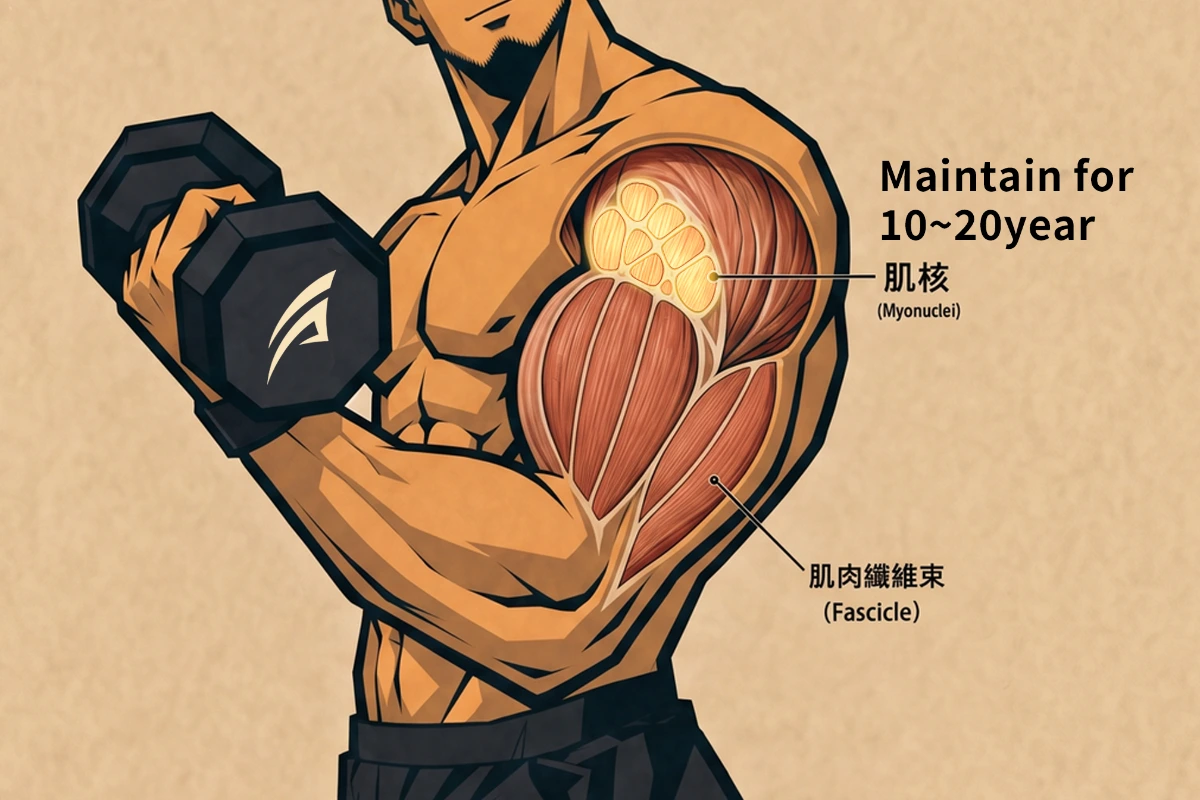
Training increases myonuclei, and these myonuclei can remain for 10 to 20 years after training cessation.
Each muscle fiber contains multiple cell nuclei, called "myonuclei." When you consistently engage in resistance training, muscle stimulation activates and divides surrounding satellite cells, which then fuse with muscle fibers, increasing the number of myonuclei.
The more myonuclei there are, the greater their influence on the synthesis of surrounding muscle proteins, making muscle hypertrophy easier. This is one reason why longer training experience leads to greater muscle growth.
This is precisely the biological basis of muscle memory. When you stop training and your muscles gradually atrophy, the number of myonuclei does not disappear simultaneously. When you resume training, these residual myonuclei can quickly reactivate protein synthesis, allowing muscles to regain their original size and strength much faster than a true beginner.
How Quickly Do Muscles Degrade After a Break?
For those with a training background, skeletal muscle mass doesn't change much after a short break, but muscle fullness and definition significantly decline.
Coach Kai shared his own observations after a two-week training break: InBody skeletal muscle mass barely decreased, but muscle fullness and definition significantly deteriorated, especially in weaker muscle groups (like shoulders) where degradation was fastest.
This suggests that a two-week break has limited impact on "absolute skeletal muscle mass," but the rate of decline in muscle quality, neural recruitment efficiency, and metabolic state is much faster than what the numbers indicate.
- For those with 2-3+ years of training experience: It usually takes about 1 month of complete cessation to feel significant muscle loss.
- Cardiovascular fitness: Just 2-3 weeks without high-intensity cardio training will lead to decline.
- Training volume required to maintain muscle mass: Research shows that only about one-third of the original training volume (with sufficient intensity) per week is needed to preserve existing muscle.
Therefore, short-term training breaks shouldn't cause excessive anxiety. For those with a training background, recovery upon return will be much faster than you expect.
Who Benefits Most from Muscle Memory?
Former trainees returning after a break can enjoy rapid progress similar to a beginner's "newbie gains" during the initial retraining phase.
Coach Kai explains that the following three types of people are most likely to achieve simultaneous muscle gain and fat loss (Body Recomposition) in the initial stages of training:
- Fitness beginners: The body is very sensitive to training stimuli and can still build muscle even in a caloric deficit.
- Returnees after a break: Due to the muscle memory mechanism, their myonuclei baseline is higher than true beginners, leading to faster and easier muscle recovery.
- Individuals with higher body fat (men >25%, women >30% body fat): They have ample stored energy, providing enough reserves to support muscle growth even in a caloric deficit.
If you've trained seriously, stopped for a while, and now want to restart, there's no need to consider yourself a complete beginner—your myonuclei assets are still there.
How Quickly Can You Return to Your Previous Level After Retraining?
For individuals with a solid training background, retraining after a two-month break typically allows them to approach their previous strength levels in 2 to 4 weeks.
Coach Kai cited a real-world example: Gyms in Hong Kong were closed for two months due to policy. His friends experienced some loss of muscle mass and strength, but after gyms reopened, it only took two weeks to restore their strength and condition to 70-80% of their previous levels.
Another perspective: if you return after a two-month break and your max lifts are only 70% of what they were, don't be alarmed—consistent, progressive training for two to four weeks usually brings you almost back to your original level. The physiological mechanism behind this is the myonuclei retention effect.
When retraining, a few points to note:
- Don't rush to use too much weight just because you see a drop in strength; gradual progression prevents injury.
- Maintain at least two training sessions per muscle group per week to sustain and accumulate protein synthesis peaks.
- Sufficient training intensity (close to failure but not necessarily to failure every time) is needed to effectively stimulate myonuclei reactivation.
Why Does Starting Training Earlier Offer Greater Long-Term Advantages?
Adolescence, with its robust hormonal activity and highest cellular synthesis capacity, is a golden period for establishing a myonuclei baseline.
Once myonuclei increase, they can be maintained for 10 to 20 years, meaning they are a true long-term asset. The earlier you start training, the higher the myonuclei baseline you accumulate, and the more efficient your future training will be.
Coach Kai specifically mentioned adolescence: with vigorous hormone secretion and the highest cellular synthesis capacity, establishing training habits early under safe guidance lays a deeper foundation for future muscle potential.
Even if you stop training due to circumstances, it doesn't mean your efforts are reset. The longevity of myonuclei ensures that every serious training session leaves a more lasting imprint on your body than you might imagine.
Frequently Asked Questions
How long after stopping training does muscle loss become noticeable?
For individuals with two to three years or more of training experience, noticeable muscle loss typically occurs after about one month of complete training cessation. Short-term breaks (within two weeks) have limited impact on absolute skeletal muscle mass, but muscle fullness and definition may show visual decline earlier.
What exactly is muscle memory? Is it just a habit of movement?
No. The true mechanism of muscle memory is the retention of myonuclei. Training increases myonuclei; after stopping training, muscles may atrophy, but myonuclei do not disappear. Upon retraining, protein synthesis can be reactivated more quickly, allowing muscles to recover much faster than a true beginner. The neurological memory of movement technique is a separate matter.
After returning to training, how long does it take to get back to the original state?
For individuals with a solid training background, even after a two-month break, progressive training for two to four weeks usually brings them close to their original strength and muscle mass levels. In the initial phase of returning, avoid rushing to lift heavy weights; gradual progression reduces the risk of injury.
Can I gain muscle and lose fat simultaneously when returning to training after a break?
Yes. Returnees after a break, due to the muscle memory mechanism, experience rapid muscle recovery. The initial retraining period is similar to a "newbie gains" phase, offering the opportunity to achieve both muscle gain and fat loss simultaneously, even without a caloric surplus. This is a unique advantage for returnees with a training background.
Do myonuclei disappear as soon as I stop training?
No. According to current research, myonuclei increased by training can be maintained for 10 to 20 years after training cessation without significant reduction. This is why individuals who have trained seriously, even years later when restarting, can recover faster than those who have never trained.
The content of this article is excerpted from Coach Kai's YouTube channel videos. Training advice is for reference only. If you experience physical discomfort or pain, please consult a professional physician or physical therapist.


