

Knees Past Toes in Squats: Will It Really Cause Injury?
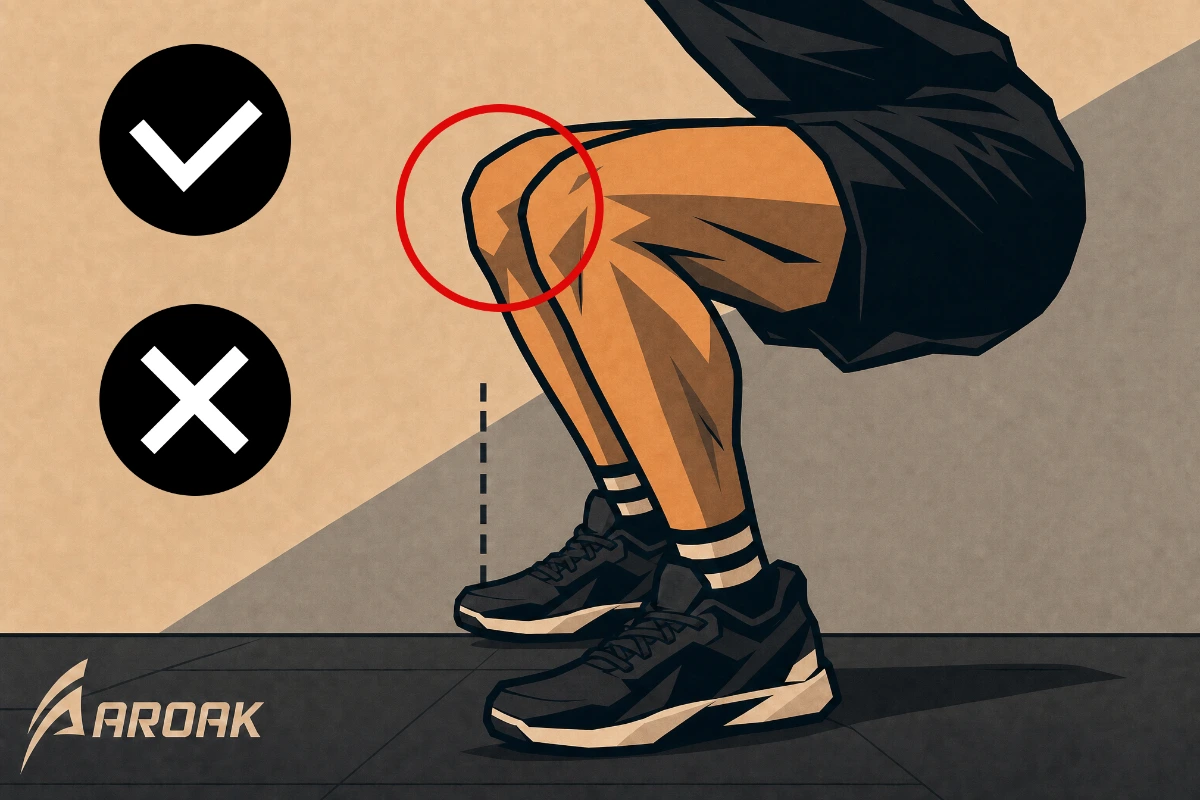
Knees going past toes does not automatically mean injury. The real risk comes from weights exceeding an individual's capacity.
"When squatting, your knees absolutely cannot go past your toes!" You've surely heard this in the gym, and perhaps this advice has made you restrict your squat form or feel anxious about it.
Coach Kai's stance is straightforward: Whether your knees go past your toes or not is not the key factor determining if you'll get injured. What truly matters is whether the weight you're currently bearing is within your body's load capacity.
Where Did This Myth Come From?
The advice "knees not past toes" had a valid original intent but was over-mythologized into an unbreakable rule.
This rule originally stemmed from a biomechanically safer posture recommendation for maximum weight squats—to minimize the torque on the knee joint.
However, the problem is that this "recommendation" became an "ironclad rule" during its dissemination, leading many people to completely avoid letting their knees go past their toes, even in bodyweight squats, light-weight training, or movements like split squats.
Coach Kai states it bluntly: "What would happen if I honestly just squatted with my knees past my toes?" The answer is—nothing would happen. Nothing is absolute.
From a Biomechanical Perspective, Knee Forward Movement Is Normal
Everyone has different skeletal proportions, and natural knee forward movement during squats is a normal physiological phenomenon.
The squat movement involves the coordinated effort of three joints: the ankle, knee, and hip. Since everyone has different mobility in these three joints and varying bone length ratios, the appearance of the movement naturally differs from person to person.
For example, someone with long femurs and relatively short tibias will inevitably need to lean forward more and their knees will move forward more to keep their center of gravity over the middle of their feet. This is a biomechanical reality, not a mistake.
If such an individual forces themselves to maintain "knees not past toes," they might instead:
- Overly straighten their torso, leading to imbalance
- Cause other joints to compensate, increasing the risk of lower back injury
- Fail to reach an effective range of motion, reducing training effectiveness
The Correct Knee Direction Is More Important Than "Knees Past Toes"
During squats, the knees should push out in line with the second toe. Avoiding knee valgus is the true key.
Coach Kai emphasizes that instead of fixating on the imaginary line of "knees past toes," it's better to focus on the direction the knees are pushing.
The correct practice is: the knees should push straight out in the direction pointed by the "index toe" (second toe). Not caving inward, nor deliberately pushing forward; just follow the direction of the toes.
Here are some basic technical points for Coach Kai's squat:
- Stance: Feet slightly wider than shoulder-width, toes pointing out about 30 degrees
- Knee direction: Push straight out, in line with the second toe
- Breathing rhythm: Inhale on the way down, exhale on the way up
- Upper body: Keep upright, core tight, glutes slightly pushed back
- Top of knee joint: Do not lock out after standing up, maintain tension in target muscles
If you notice your knees collapsing inward during the descent, Coach Kai suggests placing a resistance band just above your knees—the band's tension will force you to actively push your knees outward against the resistance, which can more effectively stimulate the gluteus medius and correct the habit of knee valgus.
Find the Correct Path First, Then Add Weight
Before each squat, use a slow eccentric motion to find the path, allowing the body to memorize the correct movement pattern before loading weight.
Coach Kai has a practical warm-up method: before each loaded set, use a 15- to 20-second ultra-slow eccentric squat to find the path.
Specifically, without any weight, spend a full 15 to 20 seconds slowly squatting to your maximum range of motion. During this process, feel if your knees and toes are aligned, if your body is stable, and if there's any deviation on one side that needs correction.
Why do this? Because when the movement speed is fast, the body relies on momentum, making it difficult to detect compensation or path deviation. Slowing down allows you to truly feel which muscles are working and which are not.
Once you find the right path, return to normal speed for effective training sets. This principle of "find the path first, then load" can simultaneously reduce injury risk and improve training efficiency.
Butt Wink Is Another Matter Entirely
Butt wink during unweighted squats is a normal phenomenon due to limited mobility; it's only a real risk with heavy weights.
Speaking of common squat posture concerns, "Butt Wink" is also an overly feared topic. Coach Kai's explanation is clear: Butt Wink is the natural posterior pelvic tilt that occurs when the hamstrings are stretched to their limit, and it is not inherently a problem.
The real risk arises when you squat so deep that your butt winks and your pelvis posteriorly tilts, while simultaneously lifting 80% to 90% of your max weight. At this point, your spine is not in a stable neutral position, yet it's bearing a huge load, which significantly increases the risk of injury.
Coach Kai's solution is direct: if you're using heavy weights, don't squat that deep; only squat to a depth where your lower back can remain stable and your hip joints are still in a neutral position.
Squats Are Not the Only Option for Leg Training
For those whose bone structure is not suited for squats, leg presses and machine squats can also effectively train the legs.
Finally, Coach Kai also points out a more fundamental issue: not everyone is suited for squats.
People with a bone structure of a short torso, long femurs, and short tibias inherently have a mechanical disadvantage in the squat movement. Forcing squats not only makes it difficult to improve movement quality but can also increase the risk of injury.
However, this does not mean leg training cannot be performed. Muscles respond to joint movements, not exercise names. As long as sufficient resistance is applied to the joint plane where the quadriceps should be active (knee extension), the muscles will grow. Leg presses, hack squats, and leg extensions can all achieve the same training goals.
So, instead of obsessing over "is my squat form standard?", ask yourself first: What is my purpose for squatting? Are there alternative options better suited for my body?
Frequently Asked Questions
Is it really okay for knees to go past toes during squats?
Coach Kai's position is: Knees going past toes does indeed place more stress on the knee joint, but as long as the weight is within your load capacity, you won't immediately get injured because of it. The real risk is the weight exceeding your personal capacity, not whether your knees cross that line.
Which direction should my knees point during squats?
Coach Kai suggests pushing your knees straight out in the direction of your second toe (index toe), avoiding knee valgus. Each person's toe angle is different, so the direction the knees push out will vary slightly, but the core principle is "knees follow toes."
What should I do if I experience butt wink during squats?
Butt wink in unweighted squats is a normal phenomenon due to limited mobility and doesn't require excessive anxiety. What you really need to pay attention to is: when using heavy weights, do not squat to a depth where your pelvis posteriorly tilts; only squat to a position where your lower back can remain stable. You can gradually improve your range of motion by stretching your hamstrings.
How can I check if my squat form is correct before squatting?
Coach Kai suggests using a 15- to 20-second ultra-slow eccentric squat to "find the path" before each loaded set—spend a full 15 to 20 seconds slowly squatting to your maximum range of motion, feeling the knee direction, body stability, and range of motion. Once you confirm the correct movement pattern, then begin loaded training.
How should people whose bone structure is not suited for squats train their legs?
Leg presses, hack squats, and leg extensions can all effectively train the quadriceps, with results comparable to squats. Coach Kai believes that no one absolutely has to squat; the key is to find exercises that are suitable for your bone structure.
This article content is excerpted from videos on the "Coach Kai" YouTube channel. Training advice is for reference only. If you experience discomfort or injury, please consult a professional doctor or physical therapist.


