


So, you have your InBody report. Now what?
InBody is a tool for tracking trends, not the sole judge of physical progress.
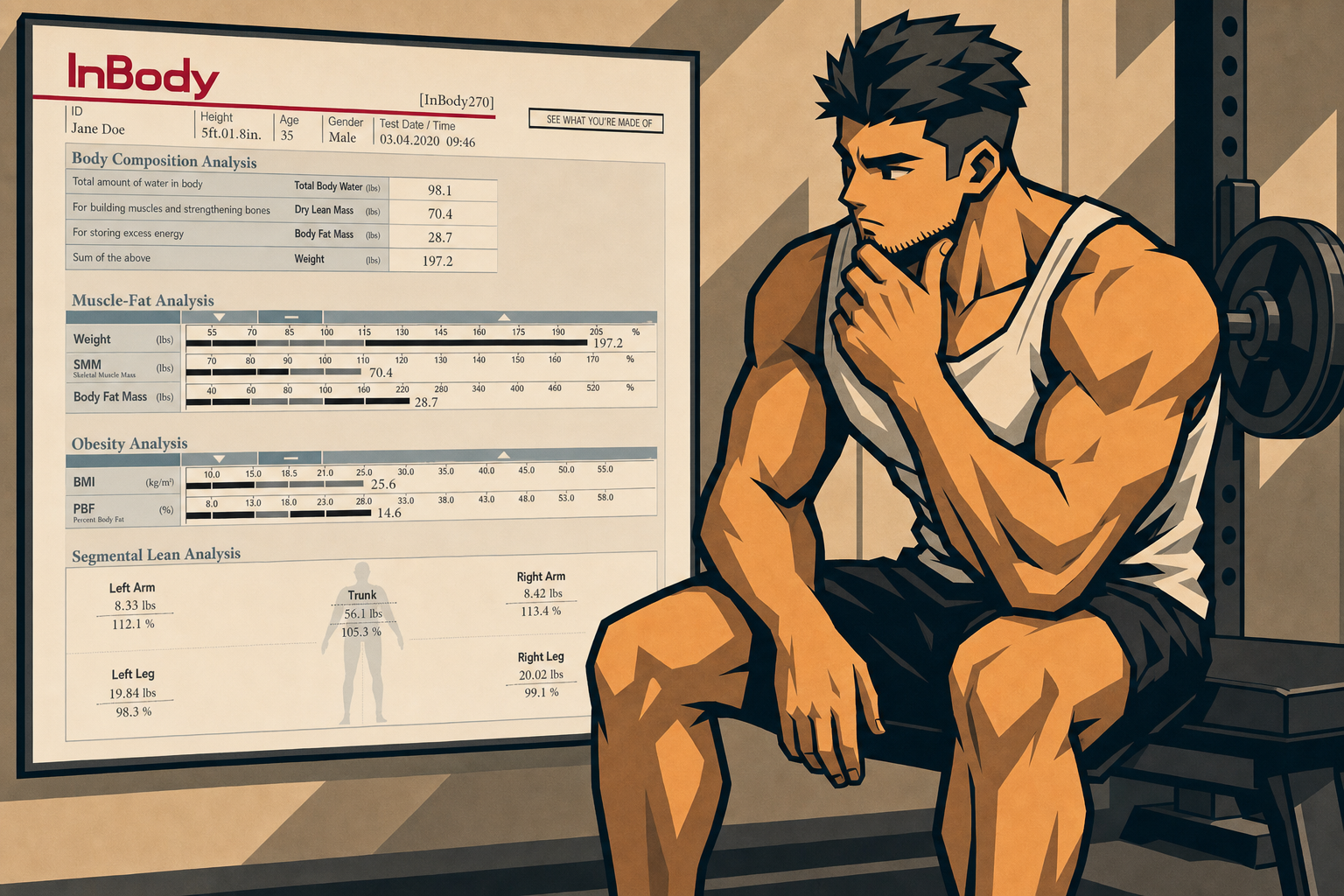
You walk out of the gym or clinic with an InBody report in hand, filled with dense numbers: 38.2 kg of skeletal muscle, 18.4% body fat, 65.1 kg of lean body mass, BMI 22.7... You stare at it for three seconds, then stuff it into your bag, unsure what these numbers mean for your training.
This is the reality for most people facing an InBody report. Some bask in the glory of a "great" body fat percentage but have no idea how to improve their physique in the mirror; others become anxious because their skeletal muscle mass hasn't increased, ignoring the fact that their squat weight has improved by 15 kg.
This article will help you understand the four most important numbers on your InBody report, how to interpret them correctly, and the most common misconceptions people fall into.
The four most crucial numbers on an InBody report
High absolute skeletal muscle mass doesn't necessarily mean you look muscular; low body fat is key for definition.
1. Skeletal Muscle Mass
Skeletal muscle is the muscle tissue you can voluntarily control and increase through training. This number is the core of the InBody report and what most gym-goers care about most.
How to interpret it? Don't just look at the absolute number; look at the trend. Coach Kai shared a specific case: when his weight was between 88 and 89 kg, his InBody showed about 45 kg of skeletal muscle, but his arm definition wasn't obvious, and he didn't look particularly muscular.
During prep, his weight dropped to 80-81 kg, and skeletal muscle mass decreased to about 41-42 kg, yet his definition became clearer, and he appeared visually more muscular. This illustrates one thing: "looking muscular" visually isn't about the absolute amount of muscle, but about the contrast between muscle mass and body fat.
2. Body Fat Percentage
This is the most easily misused and boasted-about number on an InBody report. Coach Kai's stance is very direct: no instrument can measure body fat percentage with complete precision; all values are estimates and have a certain margin of error.
He has seen people whose body fat scales showed very low numbers but had no visible abs; he also measured a relatively high number on the InBody himself during prep, when his physique was very lean. The discrepancy between the numbers and visual reality indicates that the instrument has considerable room for estimation.
Even the top-tier medical-grade InBody 770 still has a certain margin of error, let alone the entry-level equipment commonly found in gyms. As for home body fat scales, due to fewer electrodes and simpler algorithms, the error is usually greater—the numbers are only for trend reference, and should not be the primary basis for adjusting your training plan.
Correct usage: Don't chase a specific number, but rather measure regularly under fixed conditions and observe the direction of change in the numbers. If your goal is to reveal your abs, high body fat is usually one of the main reasons for their invisibility, but individual differences and muscle development also need to be considered.
3. Lean Body Mass
Lean body mass is total body weight minus fat weight, which is the sum of non-fat tissues such as muscle, bone, organs, and water. This number is very practical for dietary planning.
During muscle gain and fat loss phases, protein intake calculations are often based on lean body mass or total body weight. Coach Kai refers to training science recommendations: in high-intensity training or fat loss optimization scenarios, 2.3 to 3.1 grams of protein per kilogram of lean body mass can be consumed; for general trainees, 1.6 to 2.2 grams of protein per kilogram of total body weight is usually sufficient. Actual intake should be adjusted according to individual training intensity and goals; it is recommended to consult a professional nutritionist or doctor.
Lean body mass is also an important reference for determining whether you are preserving muscle during fat loss. If weight decreases but lean body mass is maintained, it means you're primarily losing fat; if lean body mass also drops significantly, you need to review whether your training intensity and protein intake are sufficient.
4. Weekly Average Weight Trend
Strictly speaking, this isn't a single field on the InBody report, but it is a prerequisite for interpreting all InBody numbers. Coach Kai emphasizes that the numbers from a single InBody measurement have limited significance; a comparison between two measurements taken under fixed conditions is what provides valuable reference.
Within a single day, body weight can fluctuate by as much as two kilograms due to diet, water, salt, and other factors, not to mention that InBody's bioelectrical impedance analysis is extremely sensitive to hydration status. He shared a case: after a complete 14-day break from training, his weight increased from 81.1 kg to 82.3 kg, skeletal muscle mass "slightly increased" from 41 kg to 41.2 kg, and body fat percentage only rose from 11.9% to 12.3%.
The numbers showed almost no regression, but visually his shoulders looked smaller, arm definition disappeared, and muscle fullness was gone. The reason was likely increased body water content; the increased water made the machine detect skeletal muscle mass as maintained or even slightly increased, obscuring the true regression of muscle status. This case once again confirms: numbers are always just a reference; the mirror and training performance are more honest feedback.
The four most common InBody misconceptions people fall into
A body fat percentage precise to a decimal point is an illusion; improvements in strength and appearance are the true indicators.
Misconception 1: The more precise the body fat percentage, the more meaningful it is
Many people see a body fat percentage as precise as "8.32%" and assume it's highly accurate. But Coach Kai points out directly: this sense of precision is an illusion.
All current BIA (Bioelectrical Impedance Analysis) instruments provide body fat numbers that are estimates, and the margin of error is significantly affected by body hydration status, measurement time, diet, and other factors. Even the most advanced medical-grade equipment still has a certain margin of error, let alone home body fat scales.
Misconception 2: No increase in skeletal muscle means training is ineffective
A powerlifting student once worriedly reported: "I lost 10 kg in two months, and the InBody showed 2 kg less skeletal muscle. I feel very frustrated." Coach Kai's response was: "Look at how many kilograms your squat increased? How many kilograms your deadlift increased?"
When the student said their squat improved by 10 kg and deadlift by 30 kg, Coach Kai's judgment was: "This is the most tangible progress, and you're heading in the completely right direction." If the goal is powerlifting, athletic performance is the most direct indicator; if the goal is bodybuilding, visual aesthetics are the most direct indicator. The InBody skeletal muscle number is just one reference and should not be the sole basis for judging results.
Coach Kai also mentioned that a slight decrease in skeletal muscle numbers after weight loss is largely due to fluid and glycogen loss, not necessarily the breakdown of actual muscle tissue. To determine if muscle loss is real, in addition to InBody, one should also measure various body circumferences with a tape measure and observe if strength has declined.
Misconception 3: Stagnant weight means no progress
This is the anxiety many people diligently following a fat loss plan easily fall into. If the scale doesn't budge, they feel they're stuck in place, or even suspect their training method is flawed.
Coach Kai introduced an important concept: Body Recomposition. Muscle gain and fat loss can happen simultaneously; stagnant weight doesn't mean no progress. He gave an example: a student trained for two years, then underwent a month and a half of fat loss. Their weight didn't change, but their upper body muscle mass and definition significantly improved. Coach Kai's response was: "You did lose fat, you didn't fail. You didn't lose weight, but you lost fat, and you gained muscle."
Body recomposition is most likely to occur under these conditions: when body fat is in the moderately high range (e.g., 20%), the body has enough fat to burn for energy, combined with weight training and sufficient protein intake. In this scenario, muscle can increase simultaneously with fat loss, making weight appear stagnant, but body composition has actually quietly changed.
Misconception 4: Comparing InBody numbers with others
Gyms are full of conversations like: "My skeletal muscle is 43 kg, what's yours?" or "My body fat is only 9.2%, what about you?" Coach Kai's stance on this is very clear: InBody is for personal use, not for comparing with others.
Because everyone's height, body type, fat distribution, muscle density, and skin thickness are different, the same numbers can result in vastly different appearances on different people. He himself, during prep, had very noticeable upper body definition, but his InBody still measured a relatively high number. This was because his glutes and thighs are areas where fat easily accumulates, and the definition in those areas wasn't as clear as his upper body.
Using the same instrument to track your own progress is the most valuable way to use InBody. Coach Kai suggests keeping every measurement report and comparing them every two to three months under fixed conditions, observing the direction of change in skeletal muscle and body fat. If nothing changes after several months, this result tells you: what you're doing is going in the wrong direction, and you need to adjust.
Correct InBody usage SOP
Measure at a fixed time, with fixed equipment, at a fixed frequency, then cross-reference with the mirror and training weights.
When Coach Kai was prepping, he followed this fixed procedure: Monday morning, fasted, after drinking a cup of black coffee and using the restroom, he would use an InBody 770 to measure, once every two weeks. The purpose was to ensure that the environmental variables were completely consistent for each measurement, making comparisons between two sets of numbers meaningful.
If you don't have access to the same InBody machine, here's a version that most people can follow:
- Fixed time: Always measure in the morning after waking up, after urinating, and without having eaten or drunk anything.
- Fixed frequency: Measure once every two to four weeks; don't measure daily.
- Fixed equipment: Try to use the same machine. Numbers from different brands or models are not comparable.
- Cross-validation: Combine with visual appearance in the mirror, progress in training weights, and how clothes fit, looking at all four indicators together.
Coach Kai also proposed a practical cross-validation framework: if weight increases, strength improves, appearance becomes more muscular, and InBody shows muscle gain, you're on the right track. If weight increases, strength doesn't improve, and only your waist gets tighter in your clothes, then you're primarily gaining fat and need to re-examine your diet.
Beyond the numbers, the mirror is the most honest feedback.
Numbers are merely auxiliary references; the mirror, how clothes fit, and strength are the most honest feedback.
Coach Kai once said something that best summarizes this article: "Bodybuilding is not about numbers."
The numbers on your InBody report exist to help you understand if what you're doing is right, to help you track trends when visual changes aren't apparent, and to help you find a basis for adjusting your diet and training plans. It's not a judge, not a bragging right, and certainly not the sole proof of your physical progress.
If your abs aren't visible, high body fat is usually the main reason, but muscle development and individual differences also need to be considered. If your squat weight is improving every month, regardless of whether your skeletal muscle numbers fluctuate, your muscle quality is improving. If your clothes are tighter around your shoulders and arms, regardless of whether your weight has changed, your body composition is moving in the right direction.
Detach your emotions from the numbers and look at yourself in the mirror with an objective eye—this is the attitude a hardcore trainee should have.
Frequently Asked Questions
Is the body fat percentage measured by InBody accurate?
All current BIA (Bioelectrical Impedance Analysis) instruments provide estimated body fat numbers, and their accuracy is affected by factors such as body hydration status, measurement time, and diet. Even the top-tier medical-grade InBody 770 still has a certain margin of error, and home body fat scales typically have greater errors. The correct approach is to measure regularly under consistent conditions and observe the trend of the numbers, rather than fixating on a single absolute value.
Does it mean training is ineffective if skeletal muscle mass doesn't increase?
Not necessarily. Skeletal muscle mass is just one indicator. If your training weights continue to improve (e.g., squats, deadlifts), it means your muscle strength is increasing. A slight decrease in skeletal muscle mass after weight loss may also just be due to the loss of water and glycogen, not actual muscle tissue. It's recommended to assess this in conjunction with tape measurements of body circumferences and observations of strength performance.
If my weight doesn't decrease, does that mean my fat loss plan has failed?
No. Muscle gain and fat loss can happen simultaneously, a process known as "body recomposition." This is especially true when body fat is in a moderately high range (e.g., 20%), combined with weight training and sufficient protein intake. In this scenario, muscle mass can increase at the same time as fat decreases, leading to seemingly stagnant weight, but with an actual change in body composition.
What should I pay attention to before each InBody measurement?
To ensure that each measurement is comparable, it's recommended to measure in the morning after waking up, after urinating, and without having eaten or drunk anything. Measure once every two to four weeks, and try to use the same machine, as numbers from different brands or models are not comparable.
Can I compare my InBody numbers with others?
It is not recommended. Everyone's height, body type, fat distribution, muscle density, and skin thickness are different, so the same numbers can result in vastly different appearances on different people. The most valuable use of InBody is to consistently track your own changes and trends using the same machine, not to compare yourself with others.
The content of this article is excerpted from videos on "Coach Kai's" YouTube channel. Training advice is for reference only; if you experience physical discomfort or pain, please consult a professional physician or physical therapist.


